
Faceless Assessment 2.0: Understanding the New Procedural Flow After Income-tax Bill, 2025
Introduction: Faceless assessment procedure explained.
For decades, receiving a scrutiny notice from the Income Tax Department meant repeated visits to the tax office, face-to-face interactions with the Assessing Officer (AO), and a process often clouded by subjectivity and, unfortunately, sometimes allegations of harassment or corruption.
The introduction of the Faceless Assessment Scheme marked a paradigm shift. It was a bold experiment in digitizing tax administration. Now, with the Income-tax Bill, 2025, this experiment has matured into a permanent, robust system—what we call “Faceless Assessment 2.0.”
The new Bill doesn’t just continue the scheme; it solidifies the procedural flow under Section 144B, making the “team-based approach” the standard for scrutiny assessments in India.
For taxpayers, understanding this new flow is no longer optional—it is essential for compliance. This article breaks down the mechanics of Faceless Assessment 2.0, explaining how the human element has been replaced by institutional checks and balances to ensure transparency and accountability.
The Core Philosophy: Why “2.0” is Different
The initial version of faceless assessment had teething issues. Taxpayers often felt they were shouting into a digital void, with high-pitched assessments being raised due to a lack of understanding of complex business models by the anonymous AO.
Faceless Assessment 2.0 addresses these concerns by shifting from a “single anonymous officer” model to a “dynamic team-based” model.
The core philosophy rests on two pillars:
- Anonymity: The taxpayer and the tax officer never know each other’s identity, eliminating personal bias.
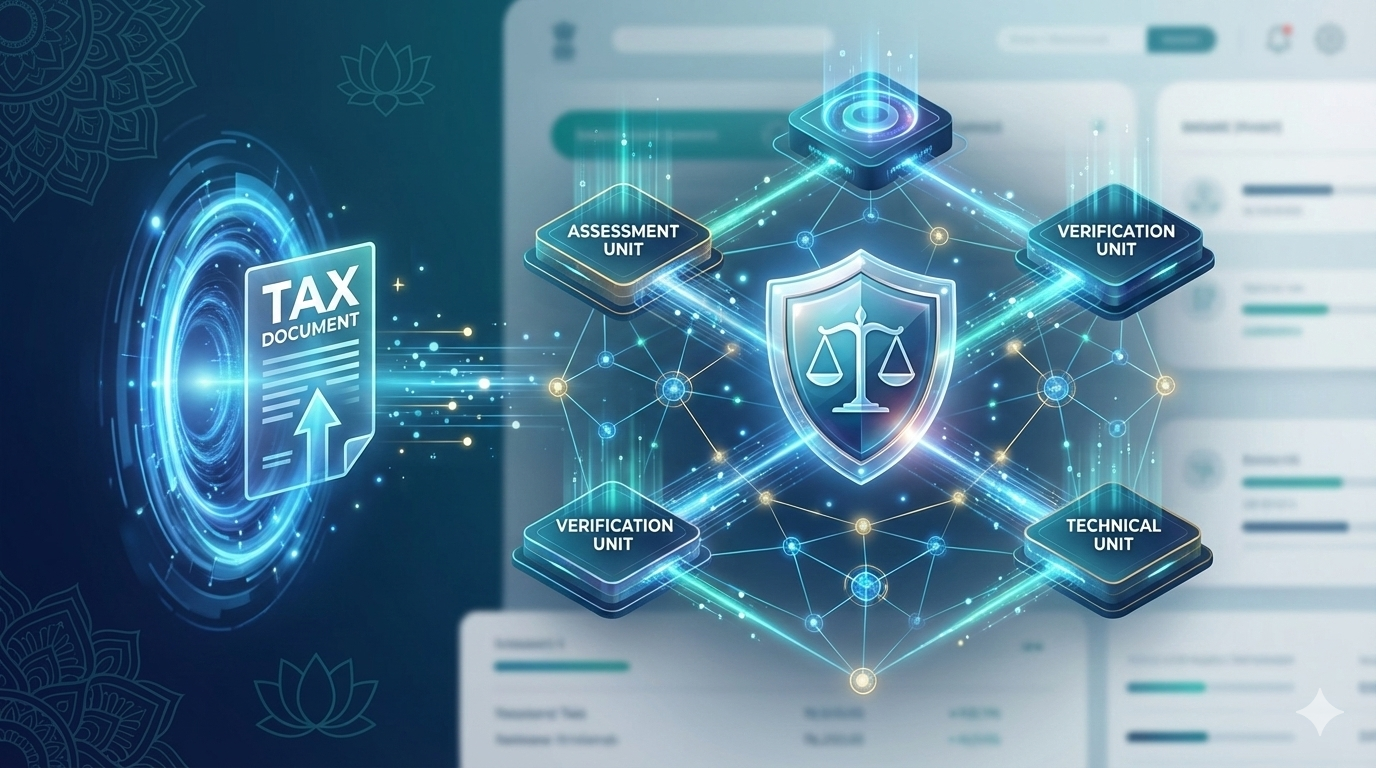
- Functional Specialization: A single assessment is no longer the responsibility of one person. It is broken down into tasks handled by specialized units located across the country, connected digitally by the National Faceless Assessment Centre (NaFAC).
The Machinery: Meet the Specialized Units
Under the formalized Section 144B procedural flow, your case is handled by distinct units functioning under NaFAC. Think of it as an assembly line of experts rather than a single craftsman.
- Assessment Unit (AU): The “Brain.” This unit identifies issues, seeks information from the taxpayer, analyzes the material, and drafts the initial assessment order. They are the primary drivers of the case.
- Verification Unit (VU): The “Investigators.” If the AU needs to verify books of accounts, examine witnesses, or conduct cross-verification with third parties, they refer it to the VU. The VU conducts the inquiry electronically and reports back.
- Technical Unit (TU): The “Specialists.” Tax law is complex. If issues arise regarding transfer pricing, international taxation, or complex valuation nuances, the AU seeks advice from the TU. This ensures domain expertise is applied.
- Review Unit (RU): The “Quality Check.” Before a draft order becomes final, the RU checks it for factual errors, legal correctness, and adherence to judicial precedents. This is a critical safeguard against high-pitched or erroneous demands.
The Crucial Difference: As a taxpayer, you only interact with NaFAC through the e-filing portal. You never interact directly with the AU, VU, or TU. NaFAC acts as the single point of electronic contact, routing information between you and these units.
Step-by-Step: The New Procedural Flow
How does this look in practice when you receive a notice? Here is the formalized flow:
Step 1: The Notice (E-Proceedings Begin) You receive a notice under Section 143(2) via email and on your e-filing portal. The notice is issued electronically by NaFAC. Immediate Action: Check the DIN (Document Identification Number) on the ITD portal to ensure authenticity.
Step 2: The Taxpayer’s Response You must submit your reply, documents, and evidence digitally through the e-filing portal within the stipulated time. The quality of your written submission is now paramount, as there is no opportunity for verbal explanation initially.
Step 3: Internal Processing by NaFAC NaFAC uses automated algorithms to assign your case to a specific Assessment Unit (AU) in any regional centre (e.g., a Mumbai taxpayer’s case might be assessed by an AU in Chennai).
Step 4: The Draft Assessment Order & The “Show Cause” Based on your replies (and inputs from VU/TU if required), the AU prepares a “Draft Assessment Order.” By law, if any addition or variation to your income is proposed, a Show Cause Notice (SCN) must be issued to you.
Step 5: The Final Opportunity (Video Conferencing) This is critical. Upon receiving the SCN proposing additions, you have the right to request a personal hearing via Video Conferencing (VC). Under Faceless 2.0, this request must be granted. This is your opportunity to present your case verbally to the AU team.
Step 6: The Final Order After considering your final reply and the VC submission, the AU finalizes the draft. It may then be sent to a Review Unit (RU) for quality control. Finally, NaFAC issues the final assessment order, computation sheet, and demand notice (if any) digitally.
The Advantages of the Formalized System
- Elimination of Human Bias: The geographical and identity disconnect ensures the assessment is based purely on facts and law, not personal perceptions.
- Uniformity in Application: With Technical Units and Review Units involved, the interpretation of law becomes more standardized across the country.
- Ease of Compliance: No more waiting in tax office corridors. Everything is handled from your desk.
- Transparency: Every notice, reply, and internal movement recorded digitally creates a robust audit trail.
Challenges: Why Professional Help is Still Crucial
While “faceless” sounds simple, the reality is complex.
- The Burden of Written Proof: Since you cannot physically demonstrate your books or explain context across a table, your written submissions must be impeccable, comprehensive, and legally sound. A poorly drafted reply can lead to disastrous additions.
- Technical Glitches: The e-portal can have downtimes or errors. Managing timelines in the face of technical snafus requires vigilance.
- Handling Video Conferencing: Presenting a complex tax argument via VC requires a different skillset than a physical hearing.
Conclusion
The formalization of Faceless Assessment 2.0 in the Income-tax Bill, 2025, signals the end of an era for traditional tax scrutiny. The system is designed to be fair, but it is also unforgiving of non-compliance or inadequate responses. The shift from “person-based” to “team-based” assessment means taxpayers must elevate the quality of their documentation and professional representation to navigate this new digital procedural flow successfully.
(Disclaimer: This article is for informational purposes based on the Income-tax Bill, 2025, and current procedural guidelines. Tax laws are subject to change. Always consult a Chartered Accountant for specific advice on your scrutiny case.)