ITR-U (Updated Return) Under Finance Bill 2026:
Everything You Need to Know About the New Framework
⚡ Key Highlights at a Glance
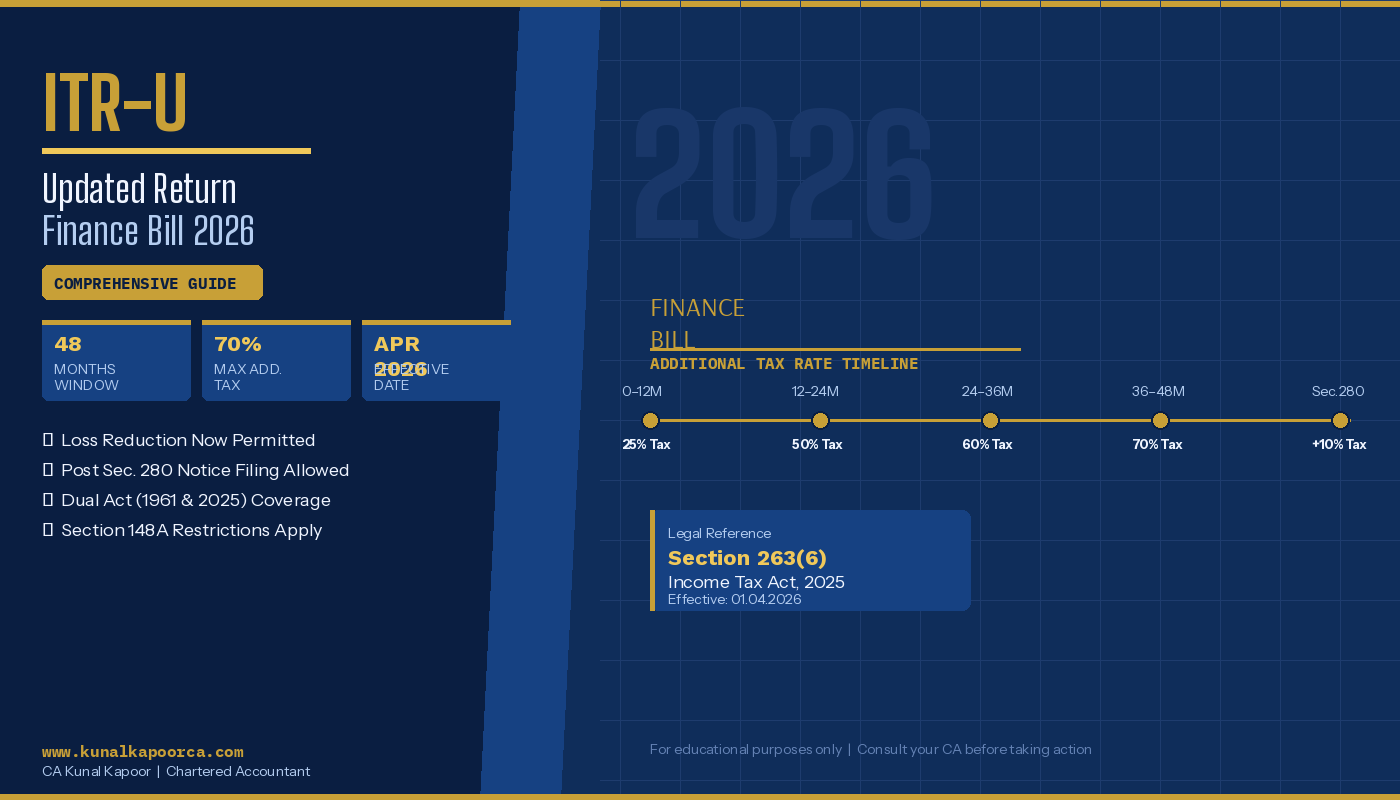
| ✅ 48-Month Window: File ITR-U up to 48 months from the end of the relevant financial year. ✅ Loss Reduction Now Permitted: Taxpayers can now reduce over-declared losses via ITR-U — a major new relief. ✅ Post Section 280 Notice Filing: ITR-U can be filed even after receiving a reassessment notice under Section 280. ⚠️ Restriction — Section 148A: ITR-U NOT permitted if Section 148A notice is issued after 36 months from end of relevant tax year. 📅 Effective Date: 1st April 2026, for Tax Year 2026–27 onwards. ⚖️ Legal Source: Finance Bill 2026 (Bill No. 3 of 2026), introduced in Lok Sabha on 01.02.2026.https://eportal.incometax.gov.in/ https://www.indiabudget.gov.in/doc/Finance_Bill.pdf |
Introduction: What is ITR-U and Why Does It Matter?
If you have missed reporting some income, made an error in your tax return, or simply forgot to include a source of income — the Income Tax Department gives you a second chance. This second chance is called the Updated Return, commonly known as ITR-U.
The Finance Bill 2026, introduced in the Lok Sabha on 1st February 2026, has proposed significant changes to the ITR-U framework under the new Income Tax Act, 2025 (which comes into force from 1st April 2026). These changes aim to make the process more taxpayer-friendly, reduce litigation, and bring more voluntary compliance into the system.
In this article, CA Kunal Kapoor provides a detailed, section-by-section breakdown of the proposed ITR-U framework under Finance Bill 2026 — covering who can file, what has changed, the additional tax implications, and practical insights for taxpayers and professionals.
1. What is ITR-U (Updated Return)?
An Updated Return (ITR-U) is a mechanism that allows a taxpayer to voluntarily file or update a previously filed income tax return to include any omitted income, correct errors, or modify reported figures — even after the original return has been filed and processed.
It is governed under Section 263(6) of the Income Tax Act, 2025 (corresponding to Section 139(8A) of the Income Tax Act, 1961). The purpose is not to re-open assessments, but to offer a self-correction tool for honest taxpayers who may have made genuine mistakes.
Who Can File ITR-U?
Any taxpayer — whether or not a return was originally filed — can file an Updated Return, subject to the restrictions outlined below. This includes:
- Salaried individuals
- Business owners and professionals
- Companies and firms
- HUFs (Hindu Undivided Families)
- Trusts and other entities
2. Key Changes to ITR-U Under Finance Bill 2026
The Finance Bill 2026 introduces three important amendments to the existing ITR-U framework. Let us understand each in detail:
2.1 Time Limit: 48 Months from End of Relevant Financial Year
Under the Finance Act, 2025 (enacted last year), the time limit for filing an Updated Return was already extended from 24 months to 48 months. Finance Bill 2026 affirms and operationalises this extended window under the new Act.
This means that for Tax Year 2022–23, a taxpayer has until 31st March 2027 to file an ITR-U. For Tax Year 2023–24, the window extends to 31st March 2028, and so on.
| Tax Year | End of Relevant FY | Last Date to File ITR-U (48 Months) |
| 2022–23 | 31st March 2023 | 31st March 2027 |
| 2023–24 | 31st March 2024 | 31st March 2028 |
| 2024–25 | 31st March 2025 | 31st March 2029 |
| 2025–26 | 31st March 2026 | 31st March 2030 |
| 2026–27 | 31st March 2027 | 31st March 2031 |
Note: The above dates are illustrative based on the 48-month rule. Please verify applicable assessment year specifics with your CA.
2.2 Loss Reduction Now Permitted — A Major Relief
This is arguably the most significant change proposed in Finance Bill 2026 regarding ITR-U.
Under the existing provisions, a taxpayer was not permitted to file an Updated Return if it resulted in a reduction of the loss originally declared. In other words, if you over-declared a business loss in your original return, there was no mechanism to voluntarily correct it via ITR-U.
Finance Bill 2026 proposes to remove this restriction. Going forward, taxpayers will be allowed to file an Updated Return even for the purpose of reducing a previously declared loss — provided the original return, belated return, and revised return were all filed within the specified due dates.
Practical Implication: This change is particularly useful for businesses and professionals who may have inadvertently over-reported losses or carried forward higher losses than what is actually admissible. Without this amendment, such errors were locked in. Now, taxpayers can correct them voluntarily, which will reduce future disputes and notices from the tax department.
2.3 ITR-U After Section 280 Reassessment Notice
Under the proposed framework, a taxpayer will be permitted to file an Updated Return even after receiving a reassessment notice under Section 280 of the Income Tax Act, 2025 (corresponding to Section 148 under the 1961 Act).
However, this comes with an additional tax cost. Section 267 of the Act will be amended to levy an additional 10% tax over and above the standard additional income-tax applicable at the relevant stage.
No Penalty in Such Cases: Importantly, no penalty under Section 439 of the Act will be levied on the income for which this additional tax is paid. This provides meaningful protection to taxpayers who choose to voluntarily disclose and pay through ITR-U even after a notice.
Similar corresponding amendments have also been proposed in the Income Tax Act, 1961 to allow updated returns in response to Section 148 notices.
3. Additional Tax Payable on ITR-U: Rate Structure
Filing an ITR-U is not free. The taxpayer must pay additional income-tax at the following rates over and above the regular tax and interest already due:
| Time of Filing (from end of relevant FY) | Additional Tax Rate |
| Within 12 months (i.e., within the Assessment Year) | 25% of additional tax payable |
| Between 12 to 24 months | 50% of additional tax payable |
| Between 24 to 36 months | 60% of additional tax payable |
| Between 36 to 48 months | 70% of additional tax payable |
| After Section 280 notice (within above periods) | Additional 10% over the applicable rate above |
The ‘additional tax payable’ is calculated on the incremental tax arising from the updated income declared — i.e., the difference between the tax as per the updated return and tax as per the original or most recently filed return.
4. Restrictions: When Can ITR-U NOT Be Filed?
The ITR-U facility is a voluntary compliance tool — it cannot be misused to reduce tax liability or demand refunds. The following restrictions apply:
| Situation | Can ITR-U Be Filed? |
| To reduce total tax liability | ❌ No |
| To claim or increase a refund | ❌ No |
| Where original return is a return of loss (new provision: unless reducing the loss) | ✅ Yes (new amendment) |
| After Section 148A notice issued within 36 months | ❌ No |
| After Section 148A notice issued after 36 months of end of relevant tax year | ❌ No |
| After Section 280 reassessment notice | ✅ Yes (with additional 10% tax) |
| Where assessment/reassessment has already been completed | ❌ No |
| Where search proceedings have been initiated | ❌ No |
5. Effective Date and Applicability
All proposed amendments to the ITR-U framework under Finance Bill 2026 will come into force from 1st April 2026, and will apply from Tax Year 2026–27 onwards (Assessment Year 2027–28).
Important: The Finance Bill 2026 has been introduced but is yet to be enacted. These are proposed amendments and are subject to change during the Parliamentary process and any further notifications. Always consult a qualified Chartered Accountant before taking action based on proposed legislation.
Source: Finance Bill 2026 — Bill No. 3 of 2026, introduced in Lok Sabha on 01.02.2026. Government FAQs on Budget 2026 published by incometaxindia.gov.in.
6. How Does ITR-U Interact with the New Income Tax Act, 2025?
From 1st April 2026, the Income Tax Act, 1961 stands repealed and replaced by the new Income Tax Act, 2025. This is a landmark shift in India’s direct tax framework.
The ITR-U provisions are now housed under Section 263(6) of the Income Tax Act, 2025 — corresponding to Section 139(8A) of the repealed 1961 Act. However, for tax years that fall under the 1961 Act (i.e., Assessment Years up to 2026–27), the parallel amendments have been made in the 1961 Act as well to ensure continuity.
This dual-framework applicability is important for tax professionals and taxpayers with pending filings under the old law.
7. Practical Guide: How to Use ITR-U Effectively
Step 1 — Identify the Error or Omission
Review your originally filed ITR to identify any income that was missed, expenses that were incorrectly claimed, or losses that were over-declared.
Step 2 — Determine the Applicable Time Window
Check the tax year for which the error exists. Based on that, calculate the applicable additional tax rate (25%, 50%, 60%, or 70%) to understand the cost of filing ITR-U.
Step 3 — Consult a Chartered Accountant
ITR-U involves computation of incremental tax, interest, and additional tax. It is highly advisable to consult a qualified Chartered Accountant to correctly compute the amounts and ensure compliance with all conditions.
Step 4 — File on the Income Tax Portal
Updated Returns are filed online on the Income Tax e-filing portal (www.incometax.gov.in). The updated ITR form requires specific disclosures about the reason for updating and the differential tax calculation.
Step 5 — Pay the Additional Tax Before Filing
The additional income-tax must be paid before or along with the filing of ITR-U. Failure to pay the requisite tax invalidates the updated return.
8. Who Should Seriously Consider Filing ITR-U?
- Individuals who received rental income but did not declare it in their ITR
- Business owners who inadvertently omitted a source of income
- Taxpayers who over-declared business losses in earlier years
- NRIs who earned income in India but did not file returns
- Professionals who forgot to include interest income, capital gains, or other passive income
- Companies whose books reflect higher profits than what was declared
Frequently Asked Questions (FAQs) on ITR-U
Q: What is the last date to file ITR-U for AY 2024–25?
A: For Assessment Year 2024–25 (Tax Year 2023–24), the relevant financial year ended on 31st March 2024. The 48-month window means the last date to file ITR-U would be 31st March 2028. However, please verify this with a CA as the rules are subject to the applicable Act under which the year is assessed.
Q: Can ITR-U be filed to claim a refund?
A: No. ITR-U cannot be filed to increase or generate a refund. It is strictly a tool for paying additional tax on omitted income or correcting upward disclosures.
Q: What happens if I file ITR-U after receiving a Section 148 / Section 280 notice?
A: Under Finance Bill 2026, filing ITR-U after a Section 280 notice is now permitted. However, an additional 10% tax (over and above the standard additional tax rate applicable at that stage) will apply. No penalty will be charged on the income for which this additional tax is paid.
Q: Can I reduce my reported losses through ITR-U under Finance Bill 2026?
A: Yes — this is a new provision proposed in Finance Bill 2026. Previously, you could not reduce a declared loss via ITR-U. Under the proposed amendment, this is now permitted, provided the original, belated, and revised returns were filed within their respective due dates.
Q: What is the additional tax I need to pay when filing ITR-U?
A: The additional tax rate is 25% of incremental tax if filed within 12 months of the end of the relevant financial year, 50% between 12–24 months, 60% between 24–36 months, and 70% between 36–48 months. In cases involving Section 280 notices, an additional 10% is levied over these rates.
Q: Is the ITR-U framework applicable under both the old and new Income Tax Act?
A: Yes. While the primary provisions are under Section 263(6) of the Income Tax Act, 2025, corresponding amendments have been made to Section 139(8A) of the Income Tax Act, 1961, ensuring the framework applies to tax years under both Acts.
Q: Is Finance Bill 2026 final? Are these changes confirmed?
A: Finance Bill 2026 has been introduced in the Lok Sabha but is yet to be enacted into law. All proposals are subject to Parliamentary approval and possible modifications. This article is based on the Bill as introduced on 1st February 2026. Always consult a CA before taking any action.
https://incometaxindia.gov.in/Documents/Budget2026/FAQs-Budget-2026.pdf
Disclaimer: This article is intended for educational and informational purposes only. The content is based on Finance Bill 2026 as introduced in Lok Sabha on 01.02.2026, Government FAQs on Budget 2026 (incometaxindia.gov.in), and publicly available sources. It does not constitute legal or tax advice. Tax laws are subject to change — please consult CA Kunal Kapoor or a qualified Chartered Accountant for advice specific to your situation. CA Kunal Kapoor is a practising Chartered Accountant registered with the Institute of Chartered Accountants of India (ICAI).