Black Money Act Penalty Relief: New ₹20 Lakh Limit & 2025 Updates.
Introduction
Imagine receiving a notice imposing a penalty of ₹10 Lakhs simply because you forgot to mention a foreign bank account with a balance of just $500 in your Income Tax Return. For years, this was the harsh reality under the Black Money (Undisclosed Foreign Income and Assets) and Imposition of Tax Act, 2015.
However, the landscape has shifted significantly in the last few months. With the Finance (No. 2) Act, 2024 introducing a statutory relief threshold and a landmark 2025 ruling by the Mumbai ITAT challenging the “automatic” nature of penalties, taxpayers have new grounds for defense.
As a Chartered Accountant practicing in Noida, I’ve seen how inadvertent errors in Schedule FA (Foreign Assets) cause panic among professionals with ESOPs and families with minor overseas investments. This guide breaks down exactly what has changed, the “Safety Net” of ₹20 Lakhs, and why the latest judicial trends are in your favor.
1. The Game Changer: The ₹20 Lakh Immunity (Finance Act, 2024)
For years, the Black Money Act (BMA) was unforgiving. Section 43 prescribed a flat penalty of ₹10 Lakh for failure to disclose foreign assets, regardless of the asset’s value (unless it was a bank account under ₹5 Lakh).
Effective October 1, 2024, the Finance (No. 2) Act, 2024, has amended the provisos to Section 42 and Section 43 of the BMA.
The New Rule:
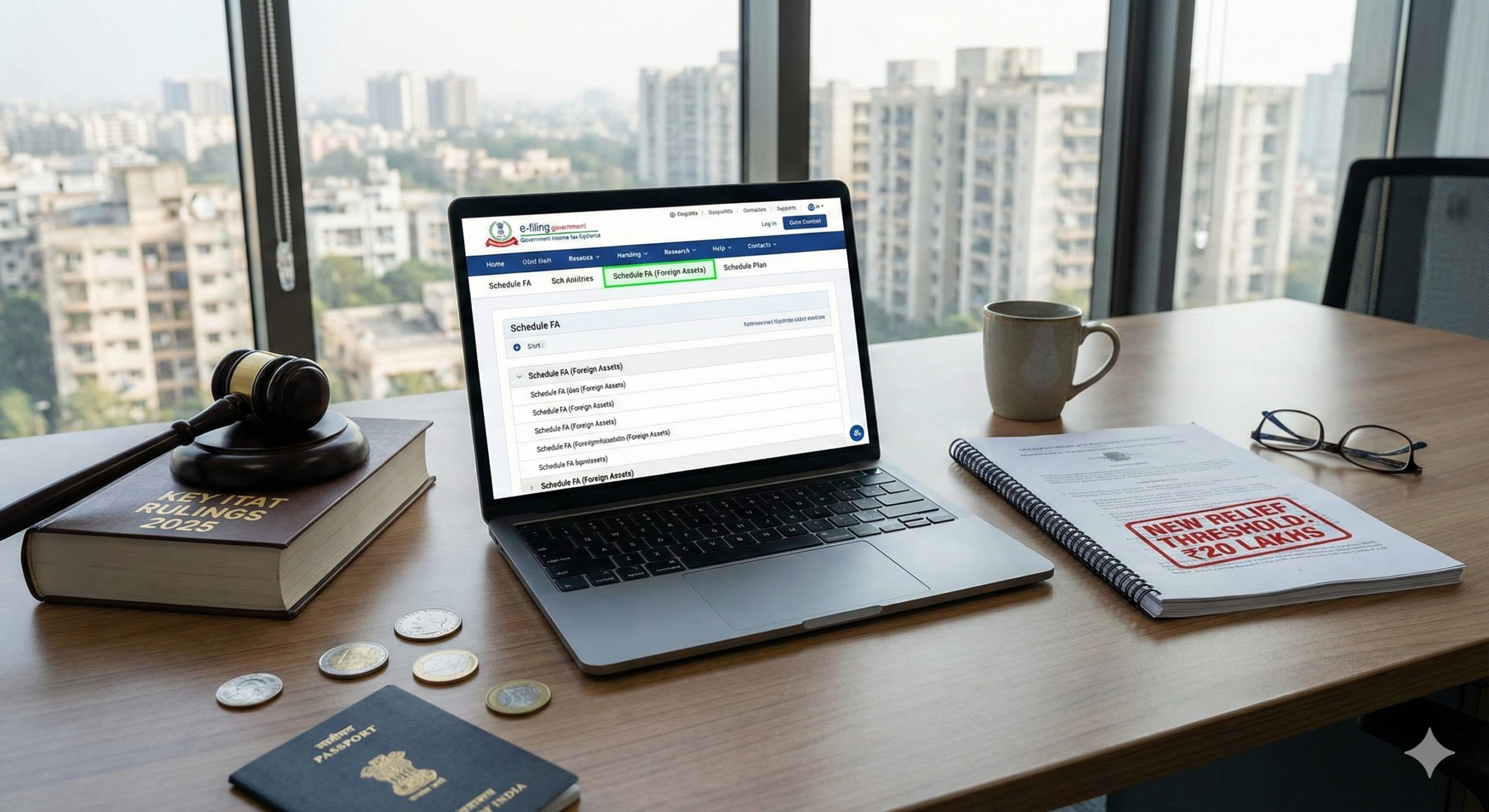
The penalty of ₹10 Lakh will not apply if the aggregate value of undisclosed foreign assets (excluding immovable property) does not exceed ₹20 Lakh at any time during the previous year.
Key Implications:
- Movable vs. Immovable: This relief applies only to movable assets like bank accounts, shares (including ESOPs), mutual funds, and insurance policies. If you own an undisclosed flat in Dubai or a plot in London, this relief does not apply, even if the value is low (e.g., a timeshare).
Prosecution Relief: Following this amendment, the CBDT issued instructions in August 2025 clarification that prosecution under Sections 49 and 50 will also not be initiated if the penalty is not leviable due to this threshold. This is a massive relief for genuine taxpayers who feared criminal proceedings for minor lapses.
2. Landmark Ruling: Vinil Venugopal v. DDIT (Inv.) (2025)
While the legislative amendment helps small cases, what about those with assets above ₹20 Lakh who made a genuine mistake?
In a significant relief to taxpayers, the Mumbai Bench of the ITAT (Income Tax Appellate Tribunal) delivered a crucial judgment in the case of Vinil Venugopal v. DDIT (Inv.).
The Core Issue:
The taxpayer had invested in foreign assets via the Liberalised Remittance Scheme (LRS) using tax-paid money. The investment was legitimate, but they inadvertently failed to disclose it in Schedule FA of their ITR. The tax officer imposed the maximum penalty, arguing that Section 43 penalties were mandatory.
The Verdict:
The Tribunal held that the word “may” in Section 43 indicates that the penalty is discretionary, not mandatory. The ITAT ruled that:
- No Automatic Penalty: Mere non-disclosure in Schedule FA does not automatically trigger the ₹10 Lakh fine.
- Reasonable Cause: If the source of funds is explained (tax-paid) and the omission is technical or venial (pardonable), the penalty should not be levied.
- Intent Matters: The BMA targets “black money” (illicit funds), not legitimate funds that were simply unreported due to oversight.
Why This Matters:
If you have received a notice for an asset acquired from white money (e.g., RSU/ESOPs from a US employer), this ruling is your primary defense strategy.
3. The Hidden Pitfalls: Where You Are Still Vulnerable
Despite these relaxations, the Black Money Act remains one of the most draconian laws in India. Here are the practical compliance traps I see clients falling into at Kunal Kapoor & Associates:
- The “Immovable Property” Trap: As mentioned, the ₹20 Lakh relief does not cover real estate. If you inherited a small property abroad or bought a fractional ownership share in a foreign property and failed to report it, you are fully exposed to the ₹10 Lakh penalty and prosecution risks.
- Schedule FA vs. Schedule AL: Many taxpayers think disclosing assets in the “Assets and Liabilities” (AL) schedule is enough. It is not. Foreign assets must be reported specifically in Schedule FA. Reporting elsewhere does not absolve you of BMA penalties.
- Signing Authority: You must report accounts where you have “signing authority,” even if the money isn’t yours (e.g., a corporate account you manage for a subsidiary).
- Crypto & Virtual Digital Assets (VDAs): The ITAT in Pune (e.g., Suhel Patanwala case) has recently scrutinized undisclosed foreign income from Bitcoin/crypto. With global information exchange, the department is tracking crypto wallets held on foreign exchanges. These are “foreign assets” liable for reporting.
4. Action Steps for Taxpayers
If you are a Resident and Ordinarily Resident (ROR) in India, here is your compliance checklist:
- Review Past ITRs: Check your Income Tax Returns for the last 5 years. Did you hold any foreign shares (Apple, Google, Tesla, etc.) or bank accounts? Were they reported in Schedule FA?
- Assess the Value: If you missed reporting, calculate the peak value.
- < ₹20 Lakh (Movable): You are likely safe from the penalty under the new amendment, but you should still regularize this in future returns.
- > ₹20 Lakh (or Immovable Property): You are at risk. Do not ignore this.
- File Revised Returns: If the window for a Revised Return (u/s 139(5)) is open (usually till Dec 31st of the Assessment Year), file it immediately to include Schedule FA.
- Handling Notices: If you receive a notice under the Black Money Act:
- Do not panic.
- Gather proofs of the source of funds (bank statements showing LRS transfers).
- Cite the Vinil Venugopal ruling to argue that the error was technical and not an attempt to hide black money.
Conclusion
The Black Money Act is evolving from a blunt instrument into a more targeted tool. The recent amendments and judicial views distinguish between “criminals” hiding illicit wealth and “citizens” making procedural errors. However, the cost of non-compliance remains high.
Need Help?
If you have received a notice under the Black Money Act or need to regularize your foreign asset reporting, professional guidance is critical to avoid the ₹10 Lakh penalty.
Contact Kunal Kapoor & Associates in Noida for specialized assistance with Black Money Act proceedings, Schedule FA compliance, and Penalty Appeals.