
Client KYC Checklist for GST: How to Avoid GST Fraud and Section 122(1A) Exposure.
In the current regulatory environment, the GST department has intensified its crackdown on circular trading and fake invoicing. For business owners, startups, and NRIs investing in India, a robust Client KYC Checklist for GST is no longer just a “good practice”—it is a legal shield. Failing to verify your business associates can lead to the suspension of your GSTIN, blocking of Input Tax Credit (ITC), and severe penalties under Section 122(1A). This blog provides a comprehensive framework to safeguard your business from fraudulent associations.
Understanding the Risk: Section 122(1A) and GST Fraud
The introduction of Section 122(1A) into the CGST Act marked a significant shift in how tax authorities view fraudulent transactions. Previously, penalties were primarily levied on the person committing the fraud. Now, any person who “retains the benefit” of a transaction involving fake invoices or wrongful ITC can be penalized with an amount equivalent to the tax evaded. This means if your vendor is a shell company, you could be held liable for their defaults.
What is Section 122(1A)?
Section 122(1A) targets the actual beneficiaries of a fraud. If you avail ITC based on an invoice where no goods or services were actually supplied, the department can levy a penalty equal to 100% of that ITC. For business owners, this creates a “joint and several” liability risk that can only be mitigated through proactive due diligence and document verification.
The Rise of Fake Invoicing
Fraudsters often create multiple layers of shell companies to pass on ITC without any underlying supply. By the time the department detects the fraud, the primary offender has disappeared. The authorities then turn to the registered businesses—the “last mile” users of that credit. A thorough KYC process helps you identify these red flags before you enter into a transaction.
Essential Components of a GST KYC Framework
To protect your business, your KYC process must go beyond collecting a GST certificate. You need to verify the identity of the promoters, the physical existence of the business, and their historical compliance behavior. This is especially critical for High Net Worth Individuals (HNIs) and startups who often engage with multiple new vendors simultaneously.
Mandatory Documents for Comprehensive GST KYC
Proprietorship | PAN & Aadhaar of Owner | Electricity/Utility Bill | Last 3 Months GSTR-3B | Partnership/LLP | PAN of Firm & Partners | Registered Rent Agreement | Partnership Deed & ITR-V | Private Limited | Certificate of Inc. (COI) | Board Resolution for Regd. Office | GSTR-2B Matching Report | NRI Investors | Passport & OCI Card | Overseas Address Proof | Tax Residency Certificate |
Real-World Example: The Impact of KYC
Consider ABC Tech Solutions, a Mumbai-based startup that sourced expensive hardware from a new vendor. Despite receiving a valid tax invoice, the vendor was later identified as a “non-existent” entity during a departmental audit. Because ABC Tech had not performed a physical site visit or checked the vendor’s filing history, the department invoked Section 122(1A), demanding a penalty of ₹15 Lakhs—the exact amount of ITC claimed. A simple KYC check could have saved them from this financial crisis.
Your Practical Client KYC Checklist for GST
Follow these 8 essential steps to ensure every new client or vendor is legitimate:
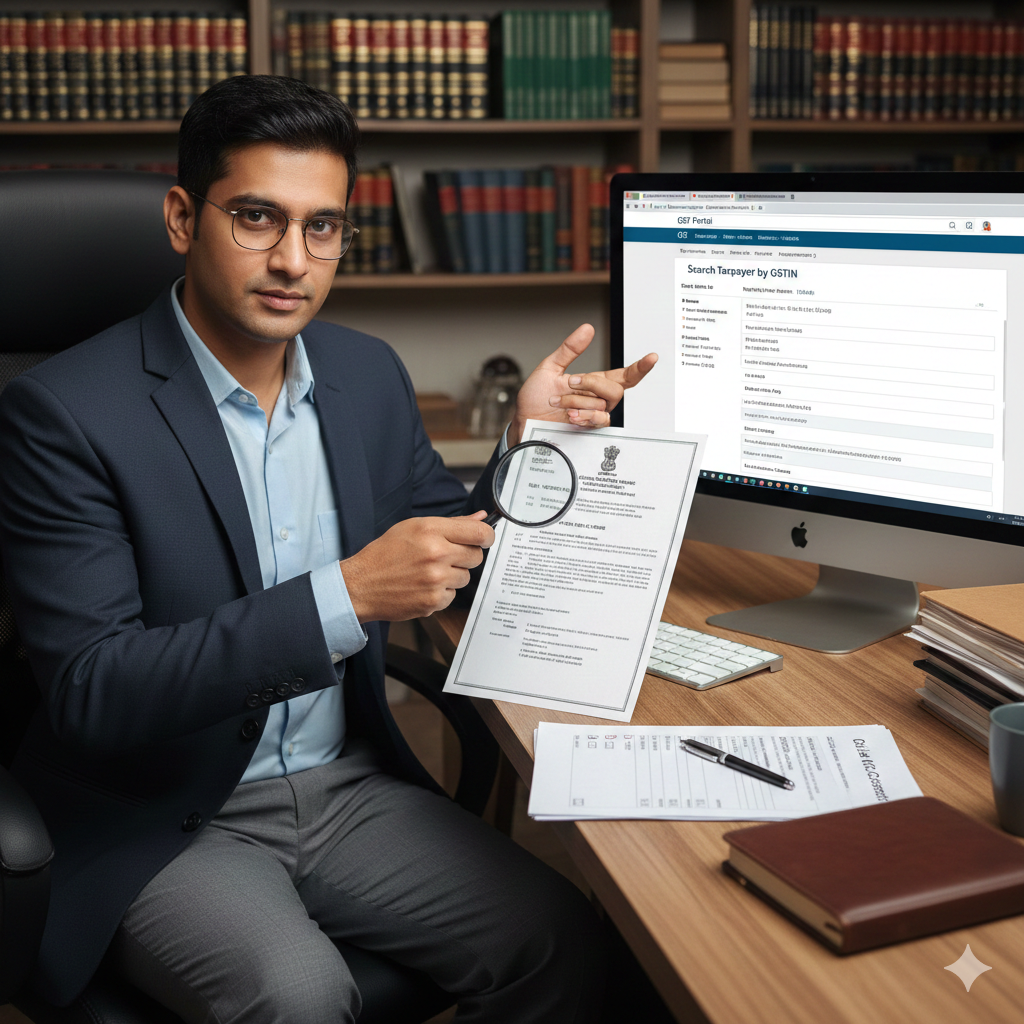
- Search Taxpayer on GST Portal: Enter the GSTIN to check if the status is “Active.”
- Verify Filing Table: Ensure they have filed GSTR-1 and GSTR-3B for the last 6 months without gaps.
- Check Registration Date: Be wary of entities that were registered very recently but are dealing in massive volumes.
- Aadhaar Authentication: Check if the promoters’ Aadhaar is authenticated on the portal; this reduces the risk of “benami” registrations.
- Match Bank Details: Ensure the bank account for payment matches the one registered on the GST portal (look for the “Bank Account Status” tab).
- Physical Address Check: Use Google Street View or request a live photo of the office premises with the GSTIN signage displayed.
- Review Nature of Business: Does the vendor’s registered “Principal Place of Business” match the goods/services they are supplying to you?
- Obtain PAN of Promoters: Cross-verify the PAN of directors/partners to ensure they aren’t associated with previously blacklisted firms.
Common Pitfalls and Mistakes
- Accepting a GST certificate without verifying its current status on the live portal.
- Failing to re-verify long-term vendors who may have stopped filing returns recently.
- Paying into a personal bank account instead of the business’s registered account.
- Assuming that a large-looking website guarantees GST compliance.
Key Takeaways
- 100% Penalty Risk: Section 122(1A) makes you liable for your vendor’s fraud if you benefit from the ITC.
- Due Diligence is Mandatory: The burden of proof often lies with the taxpayer to show they acted in good faith.
- Monitor Filing History: A vendor who doesn’t file GSTR-1 will prevent you from reflecting ITC in your GSTR-2B.
- Digital Verification: Always use the “Search Taxpayer” tool on the official GST portal for real-time data.
Frequently Asked Questions
Is it mandatory to perform KYC for every GST vendor?
While the GST law doesn’t use the term “KYC,” the “due diligence” requirement is implied. If you claim ITC from a fraudulent source, the burden is on you to prove you verified the supplier to avoid penalties under Section 122(1A).
How can I check if a vendor has filed their GST returns?
You can use the “Search Taxpayer” feature on the GST portal. After entering the GSTIN, click on the “Show Filing Table” button to see the month-wise status of their GSTR-1 and GSTR-3B filings.https://www.gst.gov.in/
What should I do if a vendor’s GSTIN is “Suspended”?
You must stop all payments and transactions immediately. A suspended status usually means the department has found discrepancies in their filings or suspects fraud. Availing credit from such a vendor will likely lead to an ITC block.
Can I be penalized if I unknowingly used a fake invoice?
Yes. Under Section 122(1A), the “intention” is secondary to the “benefit.” If you retained the benefit of the tax credit from a fake invoice, the department can levy a penalty equivalent to the tax amount involved.
What is the safest way to ensure ITC eligibility?
The safest way is to ensure 100% matching between your purchase register and GSTR-2B. Only deal with vendors who have a consistent track record of timely filing and verified physical premises.
Disclaimer
This blog is intended for general informational and educational purposes only. It does not constitute professional legal, tax, or financial advice. Tax laws, GST provisions, and corporate regulations are subject to frequent amendments. The information provided is based on laws and circulars prevailing at the time of writing. Readers are strongly advised to consult a qualified Chartered Accountant or tax professional before making any financial, tax, or compliance-related decisions. CA Kunal Kapoor & Associates shall not be held responsible for any loss, liability, or consequences arising from reliance on the information contained in this blog.
Connect With CA Kunal Kapoor
Have questions about your Client KYC Checklist for GST? CA Kunal Kapoor provides professional guidance on GST compliance and litigation for business owners, startups, HNIs, and NRIs across India. Book a consultation to discuss your specific situation and get expert advice tailored to your needs.