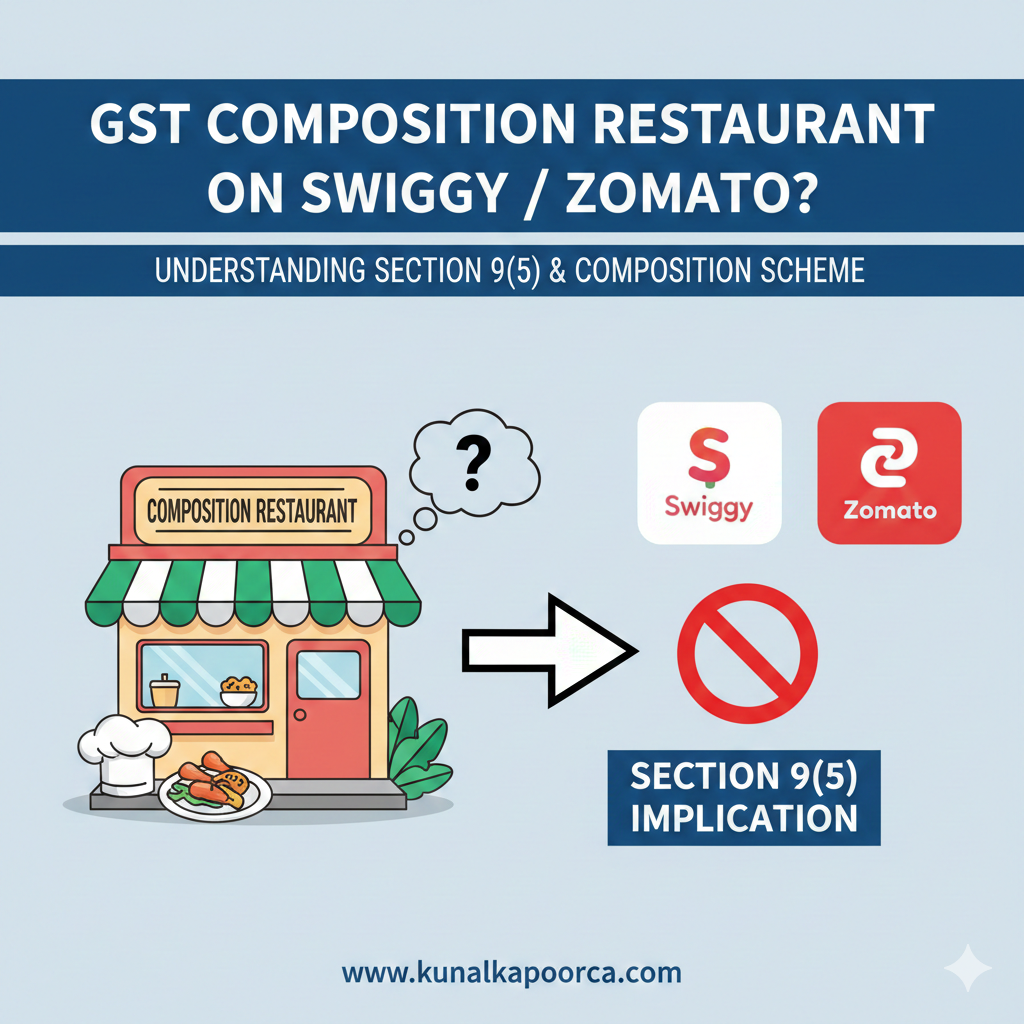
Can a GST Composition Restaurant Sell on Swiggy or Zomato? Understanding Section 9(5) and the Composition Scheme.
India’s food delivery revolution has put millions of small restaurants on platforms like Swiggy, Zomato, and Blinkit. But for small restaurant owners registered under the GST Composition Scheme, a critical question arises: Am I even legally allowed to list my restaurant on these platforms?
The answer is nuanced — and getting it wrong can expose your business to penalties, demand notices, and loss of composition status. This article breaks down the GST law clearly, so restaurant owners and their advisors can make informed decisions.
What Is the GST Composition Scheme for Restaurants? (Section 10 CGST Act)
The GST Composition Scheme under Section 10 of the CGST Act, 2017 was designed to ease the compliance burden for small taxpayers. Instead of maintaining detailed input-output records and filing monthly returns, eligible businesses pay tax at a flat, lower rate on their total turnover.
For restaurant services specifically, Section 10(1)(b) of the CGST Act applies. Restaurant service — which includes the supply of food and beverages (excluding alcoholic liquor) — is treated as a composite supply of service under Schedule II, Paragraph 6(b) of the CGST Act.
Key Features of the Composition Scheme for Restaurants
| Feature | Details |
|---|---|
| Applicable Section | Section 10(1)(b), CGST Act, 2017 |
| GST Rate | 5% (2.5% CGST + 2.5% SGST) |
| Turnover Limit (FY 2025-26) | ₹1.5 Crore (₹75 Lakh for special category states) |
| Input Tax Credit (ITC) | Not available |
| Tax Collection from Customers | Not allowed |
| Invoice Type | Bill of Supply (not Tax Invoice) |
| Returns | GSTR-4 (Annual) + CMP-08 (Quarterly payment) |
| Who Pays Tax | Restaurant pays from its own pocket |
| Display Requirement | “Composition Taxable Person, Not Eligible to Collect Tax on Supplies” must be displayed at premises and on bills |
Important: Section 10 has been amended 15 times since the original CGST Act, 2017. Restaurant owners must stay updated with each amendment to remain compliant.
The Core Conflict: Composition Scheme vs. E-Commerce Platforms
Why Is There a Conflict?
Under Section 10(2)(d) of the CGST Act, a composition dealer is expressly prohibited from supplying goods or services through an e-commerce operator who is required to collect Tax Collected at Source (TCS) under Section 52 of the CGST Act.
Platforms like Swiggy, Zomato, and Blinkit are registered e-commerce operators (ECOs) who are mandatorily required to collect TCS under Section 52. This means, in a straightforward reading of Section 10(2)(d), a composition dealer cannot sell via these platforms.
Then Why Do Some Restaurants on Composition Scheme Still Appear on Swiggy/Zomato?
This is where Section 9(5) of the CGST Act changes the picture entirely.
Section 9(5): The Game-Changer for Restaurant Services on E-Commerce
What Does Section 9(5) Say?
Section 9(5) of the CGST Act is a special provision that shifts the GST liability from the supplier (restaurant) to the e-commerce operator (ECO) for certain notified services.
Restaurant services were brought under Section 9(5) via Notification No. 17/2021 – Central Tax (Rate) dated 18th November 2021, effective from 1st January 2022.
This notification inserted the following clause:
“(iv) supply of restaurant service other than the services supplied by restaurant, eating joints, etc. located at specified premises.”
In plain language: For restaurant services supplied through platforms like Swiggy or Zomato, the e-commerce operator (not the restaurant) is liable to pay GST.
How Section 9(5) Resolves the Composition Conflict
| Legal Provision | What It Says |
|---|---|
| Section 10(2)(d) | Composition dealer cannot supply through ECO liable to collect TCS under Section 52 |
| Section 9(5) | For notified restaurant services, the ECO pays GST (not under Section 52 TCS mechanism — but under a direct liability mechanism) |
| Net Effect | Since the ECO’s GST liability for restaurant services arises under Section 9(5) — NOT under Section 52 TCS — the Section 10(2)(d) restriction does not apply |
Conclusion: A composition dealer restaurant CAN supply services through Swiggy, Zomato, or Blinkit — because the restriction under Section 10(2)(d) applies specifically to ECOs collecting TCS under Section 52, whereas for restaurant services, the ECO’s liability is under Section 9(5).
Practical Example: Understanding Through a Real Scenario
Example — Ramesh’s Tiffin Centre
Situation: Ramesh runs a small tiffin centre in Pune. His annual turnover is ₹40 lakhs. He is registered under the GST Composition Scheme and pays 5% GST (2.5% CGST + 2.5% SGST) on his turnover. He wants to list his restaurant on Swiggy to increase his customer base.
Question: Can Ramesh list on Swiggy while being a composition dealer?
Analysis:
| Step | Analysis |
|---|---|
| Is Ramesh’s service a “restaurant service”? | Yes – supply of food for human consumption (Schedule II, Para 6(b)) |
| Is Swiggy an ECO under Section 9(5)? | Yes – Notification No. 17/2021 covers restaurant services via ECO |
| Is Swiggy collecting TCS under Section 52 for restaurant services? | No – Swiggy’s liability is under Section 9(5), not Section 52 |
| Does Section 10(2)(d) restriction apply? | No – restriction is only for ECOs under Section 52 |
Answer: ✅ Yes, Ramesh CAN list his restaurant on Swiggy, provided he is not in a “Specified Premises” category.
How GST Works for Ramesh’s Swiggy Orders:
- Customer pays ₹500 for food ordered via Swiggy
- Swiggy pays 5% GST (₹25) to the government on behalf of Ramesh
- Ramesh reports these Swiggy sales in GSTR-1, Table 8 (supplies through ECO)
- The Swiggy turnover is included in Ramesh’s aggregate turnover for threshold monitoring
2025 Amendment Update: Specified Premises Changes GST Rates
What Changed from 1st April 2025?
Via Notification No. 5/2025-Central Tax (Rate) dated 16th January 2025, the definition of “Specified Premises” was revised. The concept of “Declared Tariff” has been removed.
From 1st April 2025:
| Category | Criteria | GST Rate | ITC Available? | ECO Liability (Section 9(5)) |
|---|---|---|---|---|
| Non-Specified Premises Restaurant | Actual room rate ≤ ₹7,500/night in preceding FY | 5% | No | Yes — ECO pays GST |
| Specified Premises Restaurant | Actual room rate > ₹7,500/night in preceding FY | 18% | Yes | No — Restaurant pays GST directly |
| Standalone Restaurant (No Hotel) | Independent restaurant | 5% | No | ECO pays if sold via platform |
| Composition Scheme Restaurant | Turnover ≤ ₹1.5 Crore | 5% (flat) | No | ECO pays under Section 9(5) |
Impact: Restaurant owners in hotels that previously classified themselves as “non-specified” based on declared tariff must now re-evaluate based on actual accommodation charges in FY 2024-25 to determine their GST category for FY 2025-26.
Conditions and Restrictions for Composition Dealer Restaurants
Even though composition restaurants can sell through ECOs under Section 9(5), certain restrictions remain:
What a Composition Restaurant CANNOT Do
- ❌ Collect GST separately from customers (no tax invoice)
- ❌ Claim Input Tax Credit on purchases
- ❌ Make inter-state supplies
- ❌ Supply alcoholic beverages
- ❌ Directly supply through ECO platforms where the restaurant’s own GST liability applies (i.e., for Specified Premises restaurants at 18%)
- ❌ Issue a Tax Invoice (only Bill of Supply is permitted)
What a Composition Restaurant MUST Do
- ✅ Display “Composition Taxable Person, Not Eligible to Collect Tax on Supplies” at premises and on bills
- ✅ File CMP-08 (quarterly payment statement) and GSTR-4 (annual return)
- ✅ Report Swiggy/Zomato sales in GSTR-1, Table 8
- ✅ Include ECO platform sales in aggregate turnover calculation
- ✅ File CMP-02 before 31st March to opt into the scheme for the next financial year
GST Return Reporting: How Restaurants on Composition Scheme Report E-Commerce Sales
| Return | What to Report |
|---|---|
| GSTR-1 (Restaurant) | Table 8 – Supplies made through ECO on which ECO pays tax under Section 9(5) |
| GSTR-3B (Restaurant) | Table 3.1.1(ii) – Supplies through ECO where ECO pays GST under Section 9(5) |
| GSTR-1 (Swiggy/Zomato) | Table 15 – ECO reports taxable restaurant supplies under Section 9(5) |
| GSTR-3B (Swiggy/Zomato) | Table 3.1.1(i) – ECO reports and pays GST on restaurant services |
| GSTR-4 (Composition Dealer) | Annual return; aggregate turnover includes ECO platform sales |
Frequently Asked Questions (FAQs)
1. Can a GST Composition Scheme restaurant register on Zomato or Swiggy?
Yes. Since restaurant services through e-commerce platforms are covered under Section 9(5), the GST liability shifts to the ECO (Zomato/Swiggy). The prohibition under Section 10(2)(d) applies only to ECOs collecting TCS under Section 52, which does not apply to restaurant services. Therefore, composition restaurants can list on these platforms.
2. Who pays GST when a Composition Scheme restaurant sells through Swiggy?
Swiggy (the e-commerce operator) pays GST at 5% under Section 9(5) of the CGST Act, on behalf of the restaurant. The restaurant does not collect or pay GST separately on those orders.
3. Are Swiggy/Zomato sales included in the composition dealer’s turnover limit of ₹1.5 crore?
Yes. Sales made through Swiggy, Zomato, or any other ECO are included in the restaurant’s aggregate turnover for the purpose of the ₹1.5 crore composition scheme threshold.
4. Does a composition restaurant need to file different returns for ECO sales?
The composition dealer must report ECO sales in the appropriate tables of GSTR-1 (Table 8) and GSTR-3B, and include them in GSTR-4. The ECO separately reports and pays GST in its own returns.
5. What changed for restaurant GST from April 1, 2025?
The definition of “Specified Premises” changed from being based on “declared tariff” to actual accommodation charges in the previous financial year. Hotels where rooms were actually charged above ₹7,500/night in FY 2024-25 are now “Specified Premises” and their restaurants must charge 18% GST, with ITC available, and the ECO is no longer liable under Section 9(5) for those restaurants.
6. Can a composition dealer operating a restaurant in a 5-star hotel also sell via Swiggy?
It depends on whether the hotel is a “Specified Premises.” If it qualifies as Specified Premises (actual room rate > ₹7,500), the restaurant must charge 18% GST directly — and here the composition scheme would typically not be available, as Specified Premises restaurants pay regular GST at 18% with ITC.
7. What invoicing format should a composition restaurant use for platform orders?
A composition dealer issues a Bill of Supply (not a Tax Invoice). However, since Swiggy/Zomato pay the GST under Section 9(5), the restaurant need not charge GST on its bill. The ECO manages the tax documentation on its side.
Key Takeaways for Restaurant Owners
- Composition dealers CAN sell on Swiggy, Zomato, or Blinkit — thanks to Section 9(5), which shifts GST liability to the ECO for restaurant services.
- The restriction under Section 10(2)(d) does NOT apply to restaurant services supplied through ECOs, since the ECO’s tax responsibility is under Section 9(5) — not Section 52 (TCS).
- ECO platform sales count toward your ₹1.5 crore aggregate turnover — monitor this closely.
- The 1st April 2025 amendment changed how “Specified Premises” is defined — hotel-based restaurants must re-evaluate their GST status.
- Composition restaurants must continue to file CMP-08 quarterly and GSTR-4 annually, and report ECO sales correctly.
This article is for educational and informational purposes only and does not constitute legal or tax advice. GST laws are subject to frequent amendments. Please consult a qualified Chartered Accountant before making compliance decisions.
For professional guidance on GST compliance for your restaurant business, visit www.kunalkapoorca.com