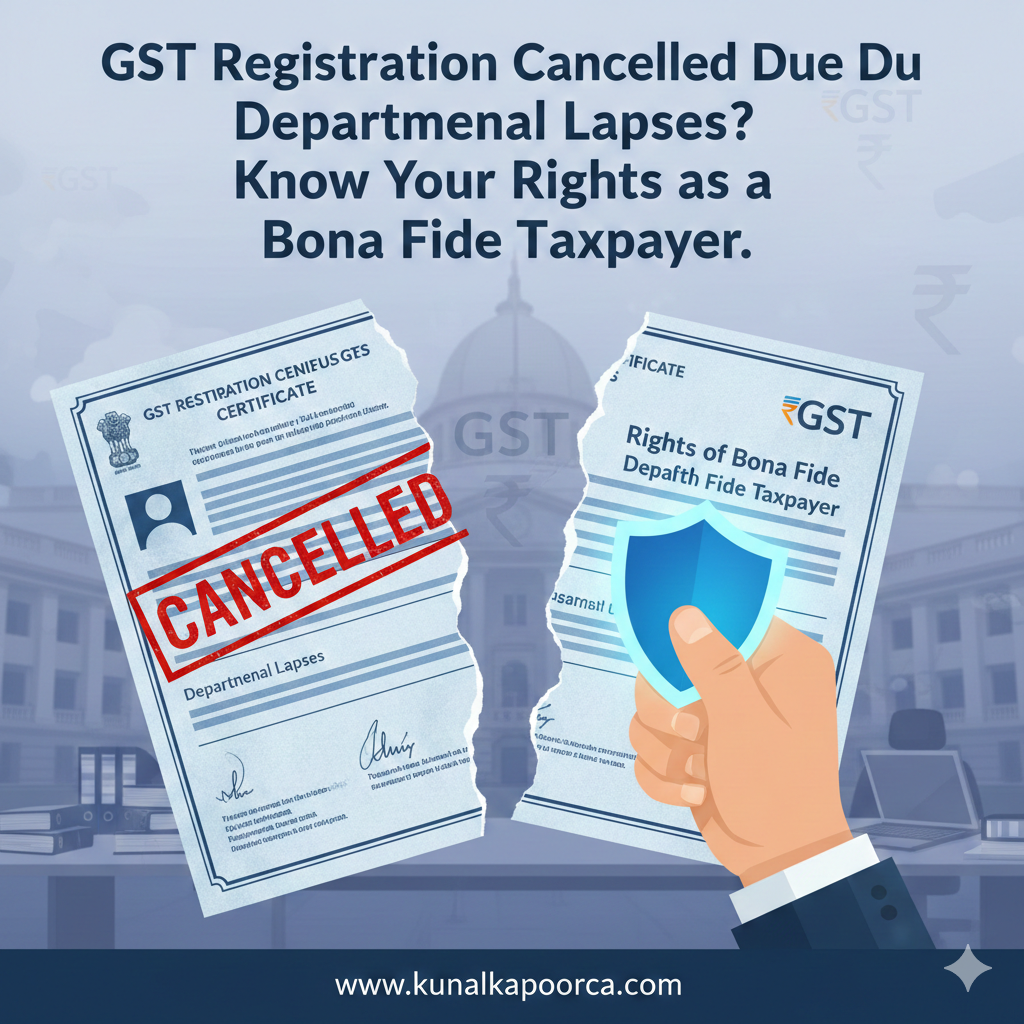
GST Registration Cancelled Due to Departmental Lapses? Know Your Rights as a Bona Fide Taxpayer.
The Goods and Services Tax (GST) regime was designed to create a seamless, technology-driven tax ecosystem. Yet, a troubling pattern has emerged across India — honest, bona fide taxpayers are being penalised for mistakes they never made. Departmental lapses in the GST registration process are enabling fake entities to mushroom, and when the fraud is eventually detected, it is often the innocent downstream taxpayer who bears the brunt.
This article examines how systemic failures at the registration stage create fertile ground for fake entity fraud and circular trading scams, and what genuine taxpayers can do to protect themselves.
Understanding Departmental Lapses in GST Registration
Under the GST framework, the registration process is a critical first gate. It is at this stage that the authenticity of a taxpayer — their identity, business premises, and financial background — is supposed to be verified. However, in practice, several systemic gaps have allowed fraudulent entities to obtain GST registration with minimal scrutiny.
Common Departmental Failures at the Registration Stage
| Type of Lapse | Description | Impact |
|---|---|---|
| Inadequate Physical Verification | Granting registration without verifying whether the business premises actually exists | Fake entities get registered using fictitious or borrowed addresses |
| Document Verification Failure | PAN, Aadhaar, and bank details not cross-verified with source databases | Fraudsters use stolen/forged identity documents to obtain GSTIN |
| Lack of Risk-Based Profiling | New applicants with suspicious patterns (e.g., same mobile, IP, or address) registered without flagging | Organised syndicates create multiple fake GSTINs from a single location |
| Absence of Post-Registration Monitoring | No systemic review of newly registered entities for initial return filing behaviour | Fake entities remain active for months, generating fraudulent Input Tax Credit (ITC) |
| Delayed Cancellation Action | Cancellation of suspicious GSTINs takes months after red flags are noticed | Fraudulent ITC flows downstream to genuine taxpayers during this window |
Key Takeaway: The GST department’s own verification failures create the very fake entities whose fraudulent ITC then contaminates the supply chains of honest businesses.
How Fake Entity Fraud Victimises Bona Fide Taxpayers
When a fake entity issues a GST invoice to a genuine buyer, that buyer has no reliable way to know — at the time of purchase — that the supplier is fictitious. The buyer pays GST as part of the invoice amount, claims the Input Tax Credit (ITC) in their GSTR-3B return, and believes they are fully compliant.
Months later, when the department detects that the supplier was a fraudulent entity, it initiates recovery proceedings — not only against the fraudster (who has vanished) but also against every genuine taxpayer who claimed ITC from that supplier.
The Downstream Impact on Genuine Businesses
- ITC already claimed is demanded back with interest
- Penalty proceedings are initiated under Section 74 of the CGST Act
- Business bank accounts may be provisionally attached
- Criminal proceedings under Section 132 may be threatened
- Reputation and banking relationships of the taxpayer suffer
Illustrative Example:
Mr. Ramesh runs a textile trading business in Mumbai. He purchases fabric worth ₹50 lakh from “M/s Sunrise Fabrics” — a GSTIN-registered entity — and pays ₹9 lakh as GST (at 18%). He claims ₹9 lakh as ITC in his GSTR-3B.
Eight months later, the GST department discovers that “Sunrise Fabrics” was a fake entity registered using a forged Aadhaar. Its GSTIN is cancelled. The department now issues a show cause notice to Mr. Ramesh demanding reversal of ₹9 lakh ITC along with 24% interest and 100% penalty — a total demand of approximately ₹20+ lakh. Mr. Ramesh, despite having genuine business transactions and payment proof, is left fighting a legal battle through no fault of his own.
Circular Trading in GST: How Departmental Lapses Enable the Fraud
What Is Circular Trading Under GST?
Circular trading is a coordinated scheme where multiple entities — often all fake or shell companies — issue invoices to each other in a circle, without any actual movement of goods or services. The sole purpose is to generate a paper trail of “purchases” to manufacture fraudulent ITC.
| Step | What Happens | Who is Harmed |
|---|---|---|
| Step 1 | Entity A issues invoice to Entity B (no actual supply) | Public exchequer — tax never actually paid |
| Step 2 | Entity B issues invoice to Entity C | Each entity in the chain shows “ITC available” |
| Step 3 | Eventually, a genuine taxpayer (Entity D) unknowingly buys from Entity C | Bona fide taxpayer claims ITC in good faith |
| Step 4 | Fraud is detected; circular chain entities disappear | Entity D faces ITC demand, interest, and penalty |
Why Departmental Lapses Are the Root Cause
Each entity in the circular trading chain holds a valid GSTIN. If the department had applied proper due diligence at registration — verifying premises, cross-referencing linked PAN details, monitoring return-filing behaviour — many of these entities would never have been registered. The department’s own failure to maintain a clean registration database is therefore a foundational enabler of the fraud.
Legal Position: Can a Bona Fide Taxpayer Be Held Liable for GST Registration Fraud?
This is one of the most critical — and contested — questions in GST jurisprudence today. Several High Courts have ruled in favour of genuine taxpayers, holding that when a buyer has exercised reasonable due diligence, they cannot be penalised solely because the supplier turned out to be fraudulent.
Key Judicial Positions
| Court / Forum | Principle Established |
|---|---|
| Various High Courts | A bona fide purchaser who has verified GSTIN and received goods/services cannot be denied ITC merely because the supplier was later found to be fraudulent |
| GST Council Deliberations | Discussed the need for greater departmental accountability in registration verification before initiating recovery from recipients |
| CBIC Circulars | Guidance has been issued on the need to distinguish between cases of connivance and cases of innocent receipt of fraudulent invoices |
Important Note for Taxpayers: If you receive a show cause notice for ITC reversal related to a supplier later found to be fraudulent, the key defence is proving that you acted in good faith, paid actual consideration, and received actual goods/services. Always maintain robust transaction documentation.
Practical Steps to Protect Yourself from GST Registration Fraud
Before Transacting with a New Supplier
| # | Due Diligence Step | How to Do It |
|---|---|---|
| 1 | Verify GSTIN on the official portal | Visit www.gst.gov.in → Search Taxpayer → Enter GSTIN |
| 2 | Check return filing status | Verify that the supplier has been regularly filing GSTR-1 and GSTR-3B |
| 3 | Cross-check PAN and business name | Confirm PAN details match GST portal records |
| 4 | Verify physical address | For high-value transactions, physically verify or request utility bill / lease deed |
| 5 | Maintain evidence of actual supply | E-way bills, lorry receipts, delivery challans, warehouse receipts |
| 6 | Retain payment proof | Bank transfer records showing payment to supplier’s bank account (never cash for high-value deals) |
| 7 | Reconcile GSTR-2B before claiming ITC | Claim ITC only for invoices reflecting in your GSTR-2B to ensure supplier has reported the supply |
What Reforms Are Needed to Fix Departmental Lapses in GST Registration?
Addressing this problem requires systemic reform at the departmental level. Some key measures that experts and practitioners have called for include:
Recommended Systemic Reforms
- Mandatory physical verification for all new GST registrations, especially where the proprietor has no prior tax filing history
- Real-time biometric authentication of all applicants before GSTIN is granted
- Centralized AI-based risk scoring at the time of registration to flag suspicious linked PAN/Aadhaar combinations
- Time-bound post-registration review — entities not filing returns for 3 consecutive months after registration should be auto-flagged
- Clear SOP to distinguish conniving recipients from innocent ones before initiating ITC recovery proceedings
- Departmental accountability — when it is proven that fraud was enabled by lax registration, the department should not be permitted to recover from innocent downstream buyers without establishing connivance
Frequently Asked Questions (FAQs) on GST Registration Lapses and Bona Fide Taxpayers
Q1. What is a bona fide taxpayer in GST context?
A bona fide taxpayer is a registered person who carries on genuine business activities, files returns in good faith, and transacts with what reasonably appears to be legitimate suppliers. They do not knowingly participate in any tax fraud or evasion scheme.
Q2. If my supplier’s GSTIN is cancelled after I claimed ITC, will I be penalised?
Not automatically. The key question is whether you exercised reasonable due diligence at the time of the transaction. If you verified the GSTIN, received actual goods/services, made genuine payment through banking channels, and the invoice reflects in your GSTR-2B, you have strong grounds to defend your ITC claim. Each case is fact-specific; consult a GST professional immediately upon receiving a notice.
Q3. What is the difference between fraudulent ITC and bonafide ITC claim?
Fraudulent ITC involves knowingly claiming credit against fake invoices where no actual supply or payment occurred. A bona fide ITC claim is one where the taxpayer genuinely received goods or services, made actual payment, and claimed credit in good faith based on available documentation. The intent and evidence of actual transaction are the distinguishing factors.
Q4. How can I report a suspected fake GST entity?
You can report suspected fake GST registrations to your jurisdictional GST office or through the GSTN anti-evasion helpline. The department encourages whistleblower information to detect fraudulent entities early.
Q5. Is reconciling GSTR-2B before ITC claim sufficient protection against fake supplier risk?
GSTR-2B reconciliation is a necessary step but not the only one. A fake entity may still file GSTR-1 (showing the supply) before being detected, causing the transaction to appear in your GSTR-2B. Physical verification of the supplier and maintenance of transaction evidence remain equally important.
Q6. Can the GST department attach my bank account if my supplier was fake?
Under Section 83 of the CGST Act, the department can provisionally attach bank accounts during proceedings. However, this power must be exercised with due application of mind. Several High Courts have quashed arbitrary provisional attachments against genuine taxpayers. If you receive an attachment order, seek immediate legal advice.
Conclusion
The problem of departmental lapses in GST registration enabling fake entity fraud and circular trading is not merely a compliance issue — it is a question of fairness to India’s honest taxpaying community. When the system that is supposed to prevent fraud fails at the first gate, it cannot then turn around and hold innocent bona fide taxpayers solely responsible for the resulting damage.
As professionals and businesses operating in the GST environment, the most prudent approach is to build robust supplier due diligence practices, maintain comprehensive transaction documentation, reconcile GSTR-2B diligently, and seek professional guidance at the first sign of a departmental notice.
At the same time, it is equally important for the tax administration to acknowledge these systemic failures and implement meaningful reforms that protect genuine taxpayers while aggressively pursuing those who deliberately exploit the system.