Guide to Income Tax Act 2025 India & New Rules 2026 | CA Kunal Kapoor
Navigating the Income Tax Act 2025 India: A New Era of Simplification for Startups and Individuals
For over six decades, the Indian tax landscape was governed by a complex web of provisions. As a practitioner, I’ve often seen founders and individual taxpayers overwhelmed by the sheer volume of compliance. However, the wait for a modern framework is nearly over. With the Income Tax Act 2025 India set to take effect from April 1, 2026, we are witnessing a systemic shift from “policing” to “participation.”
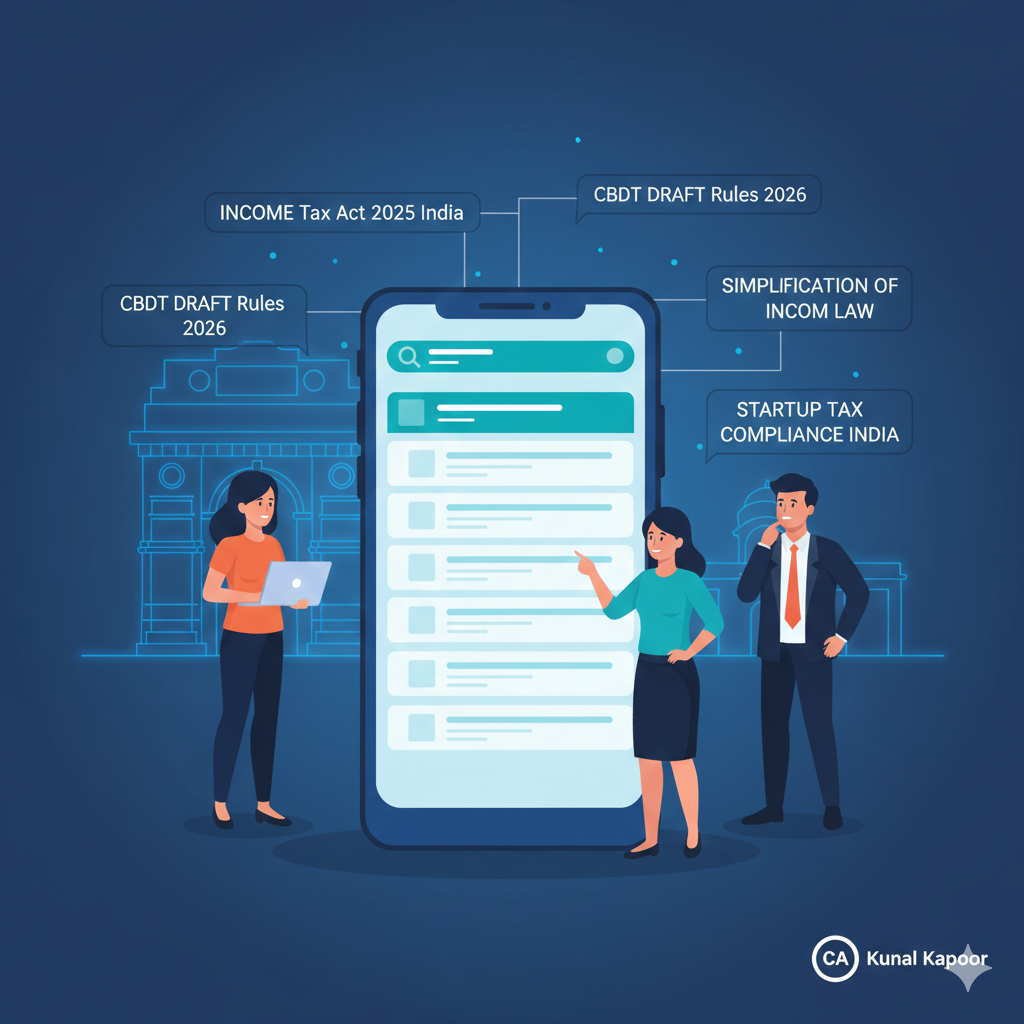
The recently released CBDT Draft Rules 2026 provide a glimpse into this future—a future where Smart Income Tax Forms and streamlined processes aim to return mental bandwidth to the people who drive our economy.
The Shift to Simplification of Income Tax Law
The primary philosophy of the new regime is the simplification of income tax law. The old framework, while robust, had become a patchwork of 511 rules and nearly 400 forms. For a small business or a growing startup, navigating this was like walking through a legal labyrinth.
Rationalizing Rules and Forms
Under the New Income Tax Rules 2026, the government has performed a significant “clean-up” operation. By removing redundancies and merging overlapping provisions, the compliance load has been slashed:
| Feature Comparison | Income Tax Rules, 1962 | Draft Income Tax Rules, 2026 |
| Total Number of Rules | 511 | 333 |
| Total Number of Forms | 399 | 190 |
| Drafting Style | Dense, Legalistic | Simple, Modern Language |
This reduction isn’t just about numbers; it’s about clarity. By replacing narrative explanations with structured tables and formulas, the CBDT Draft Rules 2026 aim to reduce the ambiguity that often leads to unnecessary litigation.
Moving from “Assessment Year” to a Unified “Tax Year”
One of the most significant changes for startup tax compliance India is the elimination of the confusing “Previous Year” (PY) and “Assessment Year” (AY) terminology.
Starting April 2026, the law introduces a single Tax Year vs Assessment Year structure.
- The Concept: A “Tax Year” will now refer to the 12-month period starting April 1st, aligning with the financial year.
- The Benefit: For founders and international investors, this brings India in line with global fiscal standards, making it easier to track reporting cycles without the “mental math” of jumping between two different year labels.
The Rise of Smart Income Tax Forms
The centerpiece of this reform is the introduction of Smart Income Tax Forms. These aren’t just digital versions of paper forms; they are system-driven compliance tools.
Key Features of Smart Forms
- Extensive Pre-filling: Leveraging the Annual Information Statement (AIS), forms will come pre-populated with data, reducing manual entry errors.
- Automated Reconciliation: The forms are designed to flag mismatches in real-time, allowing taxpayers to correct errors before submission.
- Renumbered Forms: Familiar forms are getting a makeover. For instance, the ubiquitous Form 16 (Salary TDS) is proposed to become Form 130, and Form 26AS is transitioning to Form 168.
What This Means for Startup Tax Compliance India
For the startup ecosystem, the Income Tax Act 2025 India offers several strategic advantages:
- Lowered Audit Thresholds: The bar for mandatory tax audits has been reconsidered for qualifying startups, allowing young companies to focus on R&D rather than paperwork.
- Faster Refunds: Centralized processing and data-driven decision-making mean that working capital isn’t locked up in long refund cycles.
- Technology-First Framework: The reliance on AI-based systems for verification means honest taxpayers face less intrusive manual scrutiny.
Frequently Asked Questions (FAQ)
Q1: When does the Income Tax Act 2025 come into force?
The Act is scheduled to become effective from April 1, 2026.
Q2: What are “Smart Forms” in the context of the New Income Tax Rules 2026?
These are technology-enabled forms that feature pre-filled data, automated reconciliation of tax credits, and standardized fields to reduce repetitive disclosures.
Q3: Is the old tax regime still available under the new Act?
Yes, while the new tax regime remains the default, the Income Tax Act 2025 preserves the choice between the old and new regimes for individuals, with specific rebate benefits like Section 87A being carried forward.
Q4: Do I need to upgrade my accounting software?
Yes. Businesses and startups should ensure their ERP and accounting systems are updated to reflect the new “Tax Year” structure and renumbered form formats before the April 2026 rollout.
Conclusion: Preparing for the Transition
The simplification of income tax law is a welcome change, but a “simpler” law requires a “smarter” approach to compliance. As we transition to the New Income Tax Rules 2026, the key for every individual and corporate taxpayer is early adaptation.
At the office of CA Kunal Kapoor, we are closely monitoring these updates to ensure our clients are ready for this digital-first era. To learn more about how these changes affect your specific business structure, feel free to explore our resource center.