Understanding Provisional Assessment under Section 60 of the CGST Act.
Introduction to Provisional Assessment under GST
The Goods and Services Tax (GST) regime in India is primarily based on the principle of “Self-Assessment,” where the taxpayer determines their tax liability and discharges it. However, business transactions are often complex. Whether it is a new product with an ambiguous HSN classification or a service contract with intricate valuation components, taxpayers may find themselves unable to determine the exact tax liability at the time of supply.
To prevent tax defaults and provide a legal recourse, Section 60 of the CGST Act, 2017 governs Provisional Assessment. This mechanism allows a registered person to pay tax on a provisional basis until the final liability is determined by the authorities.
When can a Taxpayer Invoke Section 60 of the CGST Act?
Provisional Assessment is a specific legal provision applicable only in two distinct circumstances:
1. Inability to Determine the Value of Supply
This occurs when the transaction value depends on factors unknown at the time of supply, such as:
- Complex post-supply discount structures.
- Disputed inclusion of incidental expenses.
- Related party transactions where “Open Market Value” is unclear.
2. Inability to Determine the Rate of Tax
Common scenarios include:
- Ambiguity between two HSN/SAC codes with different tax rates (e.g., 12% vs. 18%).
- Legal uncertainty regarding the applicability of an exemption notification.
- Difficulty in identifying the “Principal Supply” in a composite supply.
The Step-by-Step Procedure for Provisional Assessment
The process involves specific GST forms and statutory timelines:
| Step | Form | Description |
|---|---|---|
| 1. Application | GST ASMT-01 | Taxpayer applies via the common portal with supporting documents. |
| 2. Scrutiny | GST ASMT-02/03 | Proper Officer seeks clarification; Taxpayer replies. |
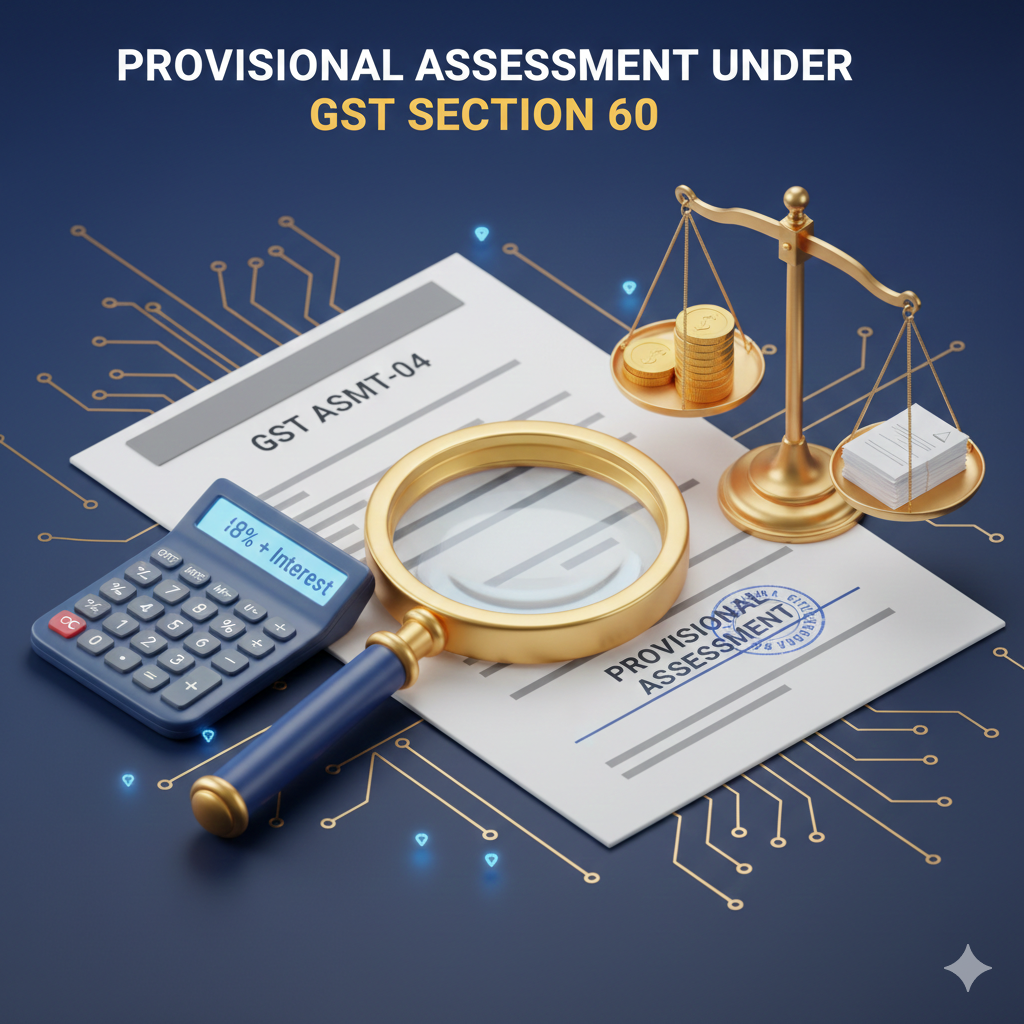
| 3. Prov. Order | GST ASMT-04 | Officer passes order within 90 days allowing provisional payment. |
| 4. Bond | GST ASMT-05 | Taxpayer executes a bond with security (max 25% of bond value). |
Statutory Timelines for Finalization of Assessment
Finalization must occur within specific limits as per Section 60(3):
- Initial Period: 6 Months from the date of the Provisional Order.
- First Extension: Up to 6 additional months (by Joint/Additional Commissioner).
- Final Extension: Up to 4 additional years (by the Commissioner).
The final order is issued in FORM GST ASMT-07.
Financial Implications: Interest on Shortfall and Refunds
Taxpayers must be wary of the interest costs associated with provisional assessment:
- Interest on Tax Shortfall: If the final tax is higher, interest @ 18% p.a. is payable from the original due date until payment.
- Interest on Refunds: If the final tax is lower, the taxpayer receives a refund with interest @ 6% p.a. (subject to Unjust Enrichment rules).
Practical Example: Classification Dispute
Imagine a company, Kunal Tech Solutions, launches a new electronic device. They are unsure if it attracts 12% GST (as a mobile accessory) or 18% GST (as a general electronic item).
- The company applies for Provisional Assessment under Section 60.
- The Officer allows them to pay 12% provisionally via ASMT-04.
- Six months later, the final order (ASMT-07) classifies the item at 18%.
- Kunal Tech Solutions must pay the 6% difference plus 18% interest calculated from the day the first return was due.
Frequently Asked Questions (FAQs)
Q1. Can I use Section 60 to determine the Place of Supply?
No. Provisional assessment is strictly limited to Value and Rate of tax. It cannot resolve disputes regarding the “Nature of Supply.”
Q2. When is the security (Bank Guarantee) released?
Upon the final assessment and payment of any differential tax, the taxpayer applies in ASMT-08, and the officer releases security via ASMT-09.
Conclusion
Section 60 is a vital safety valve for businesses facing genuine technical ambiguities. While the 18% interest on shortfalls is a cost factor, it protects against penalties for “suppression of facts.” For expert review of your specific case, professional consultation is always recommended.