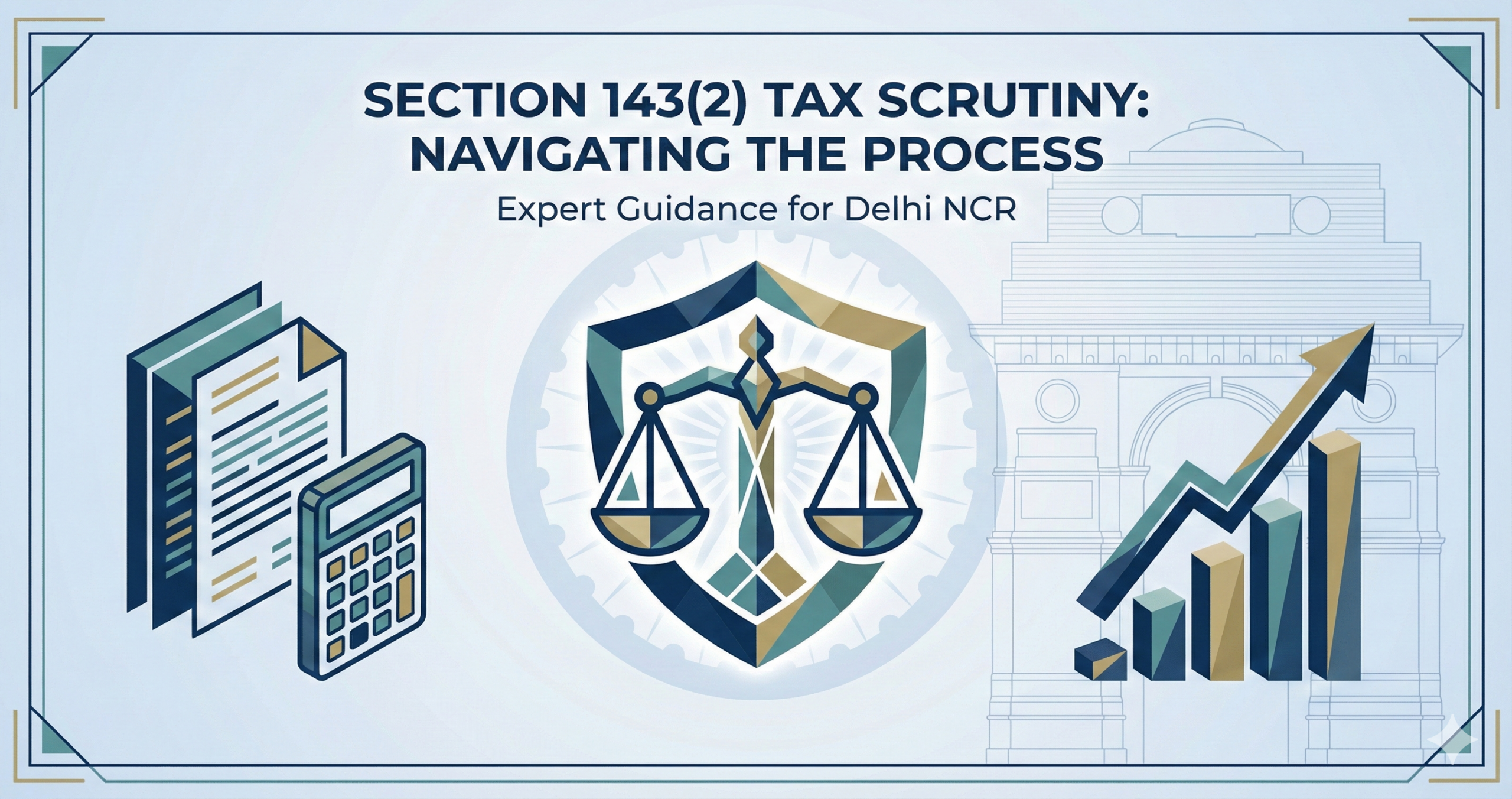
Received a Section 143(2) Notice? Here’s Your Action Plan for AY 2024-25
Understanding the timelines, process, and necessary steps to resolve Income Tax scrutiny assessment in the faceless regime
For businesses and professionals operating in the bustling economic hubs of Delhi NCR, receiving a communication from the Income Tax Department can be unsettling. Among the various types of notices, a notice under Section 143(2) of the Income Tax Act, 1961, often causes the most anxiety. This notice signifies that your Income Tax Return (ITR) has been selected for “Scrutiny Assessment.”
Unlike a routine processing intimation, a Section 143(2) notice means the Assessing Officer intends to examine your return closely to ensure you have not understated your income, computed excessive losses, or underpaid taxes.
Given the high volume of high-value transactions in areas like Gurgaon, Noida, and Delhi, scrutiny selections are not uncommon. However, panic is not the solution—preparation is. This guide will demystify the scrutiny process for Assessment Year (AY) 2024-25 and outline how to navigate it successfully under the current faceless assessment regime.
What Triggers a Section 143(2) Notice?
In today’s digital tax environment, scrutiny selection is rarely random. It is primarily driven by data analytics and algorithms used by the Central Board of Direct Taxes (CBDT). The system flags returns where information provided by the taxpayer does not match third-party data available to the department.
Common triggers include:
- AIS/TIS Mismatches: Significant discrepancies between your filed ITR and the data reflected in your Annual Information Statement (AIS) or Taxpayer Information Summary (TIS) regarding interest income, dividend, securities transactions, or high-value purchases.
- High-Value Transactions: Large cash deposits, credit card payments exceeding certain limits, or substantial property transactions in Delhi NCR that don’t align with reported income.
- Sudden Income Fluctuations: A significant drop in income or a sharp rise in expenses compared to previous years without a clear explanation.
- Specific Claims: claiming large refunds or substantial relief under specific sections (like capital gains exemptions) can sometimes trigger a review.
Types of Scrutiny: Limited vs. Complete
Understanding the scope of the inquiry is crucial. The notice will usually specify the type of scrutiny:
- Limited Scrutiny (CASS – Computer Assisted Scrutiny Selection): The inquiry is restricted to specific, identified issues. For example, the department may only want to verify the source of a ₹20 lakh cash deposit. You are only required to provide details related to that specific point.
- Complete Scrutiny: This is a comprehensive review of the entire return. The Assessing Officer will examine books of accounts, bank statements, and supporting documents for all income and expense heads to verify the overall correctness of the ITR.
Critical Timelines for AY 2024-25
For returns filed for the Financial Year 2023-24 (Assessment Year 2024-25), adhering to timelines is critical for both the department and the taxpayer.
- Deadline for Issuing Notice: The department must issue the Section 143(2) notice within three months from the end of the financial year in which the return was filed. For most returns filed for AY 2024-25, this deadline is June 30, 2025. If you receive a notice after this date, it may be invalid in the eyes of the law.
- Deadline for Completing Assessment: The deadline for the department to complete the scrutiny assessment and pass a final order is currently March 31, 2026, for the AY 2024-25.
The Faceless Assessment Ecosystem
Gone are the days of carrying bulky files to the Income Tax Office and meeting the Assessing Officer physically. The entire scrutiny process is now “Faceless.”
- All Communication Online: The notice is sent to your registered email and appears on your e-Filing portal.
- Dynamic Jurisdiction: Your case is not handled by your local jurisdictional officer in Delhi or NCR. It is randomly assigned by an algorithm to an assessment unit anywhere in India, ensuring anonymity and reducing potential corruption.
- Digital Responses: All replies, documents, and evidence must be submitted electronically through the e-Filing portal.
Actionable Steps: How to Respond Effectively
If you receive a 143(2) notice, ignoring it is the worst possible strategy. Follow these steps:
1. Verify the Notice Always authenticate the notice on the e-Filing portal using the Document Identification Number (DIN) to ensure it is genuine.
2. Do Not Panic, But Act Quickly Acknowledge receipt of the notice online. Note the timeline provided for the initial response (usually 15 days).
3. Engage a Chartered Accountant Scrutiny proceedings are technical. A slight misstep in your explanation can lead to substantial additions to your income. Engaging a specialized CA firm in Delhi NCR with experience in faceless assessments is highly recommended to draft appropriate legal responses.
4. Gather Documentation Based on the issues raised (limited vs. complete scrutiny), compile necessary proofs. This may include bank statements, loan agreements, gift deeds, invoices, or reconciliations with AIS data.
5. Submit Detailed Responses via Portal Your CA will help you draft a point-by-point rebuttal to the queries raised, attaching relevant documentary evidence on the portal. Ensure the submission is clean, organized, and directly addresses the Assessing Officer’s queries.
Risks of Non-Compliance
Failing to respond to the Section 143(2) notice or subsequent questionnaires (under Section 142(1)) has severe consequences:
- Best Judgment Assessment (Section 144): The officer will assess your income based on their “best judgment” using available material, which usually results in a high tax demand.
- Penalties: Penalty of ₹10,000 for each failure to respond (Section 272A), plus penalties for under-reporting income ranging from 50% to 200% of the tax payable.
Conclusion
A Section 143(2) scrutiny notice is a serious compliance requirement, but it is also an opportunity to demonstrate the genuineness of your filed return. With the shift to faceless assessment, the emphasis is entirely on the quality of digital documentation and professional representation.
For businesses and individuals in Delhi NCR facing scrutiny, timely action and expert guidance are paramount.
Have you received an Income Tax scrutiny notice? Do not navigate this complex process alone.
Contact our expert CA team today for a consultation and ensure a robust defense for your scrutiny assessment.