Understanding Rule 86B: Impact on ITC Utilization.
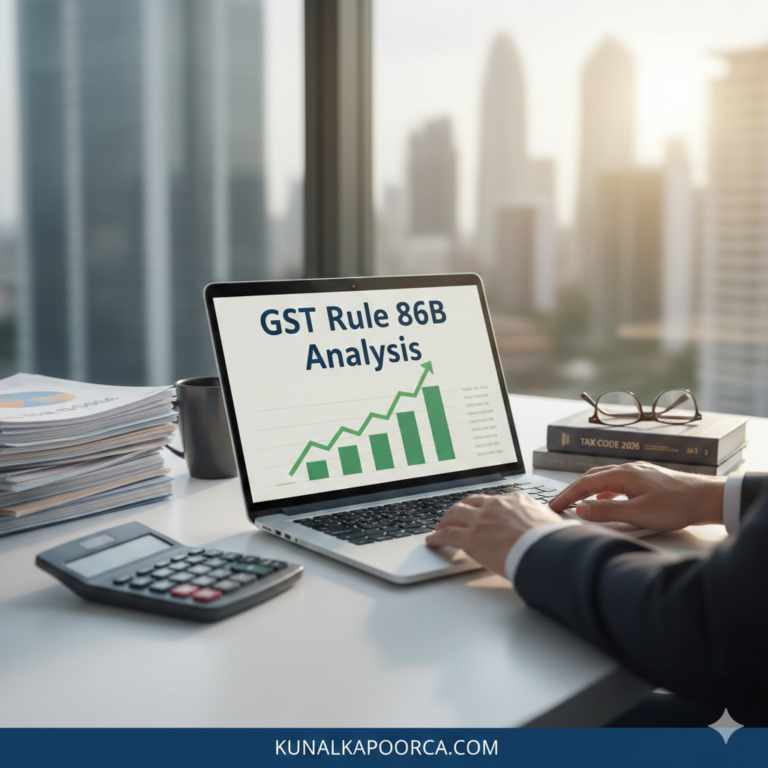
The Goods and Services Tax (GST) framework in India is dynamic, frequently introducing measures to curb tax evasion and streamline compliance. One such pivotal regulation is Rule 86B of the CGST Rules, 2017. Introduced to target “fake invoicing” and fraudulent credit claims, this rule mandates a minimum cash payment of tax liability for specific taxpayers.
As we navigate the 2026 compliance landscape, understanding how the 1% cash payment rule interacts with your ITC utilization is essential for effective working capital management.
1. What is Rule 86B GST and its Primary Objective?
Rule 86B GST imposes a restriction on the use of the Input Tax Credit (ITC) available in the electronic credit ledger. Specifically, it limits the discharge of output tax liability through ITC to 99%. This means that at least 1% of the output tax liability must be paid in cash via the electronic cash ledger.
The primary objective of this rule is to prevent “fly-by-night” operators from showing massive turnovers and setting off their entire liability using fake or circular-trading-based ITC. By requiring a cash component, the government ensures a financial trail and actual tax contribution from high-turnover entities.
2. Applicability: Who is Under the 1% Cash Payment Rule?
The ITC utilization restriction under Rule 86B does not apply to everyone. It is specifically targeted at businesses with substantial monthly turnovers.
The Threshold Criteria
The rule is triggered if the value of taxable supply (excluding exempt supplies and zero-rated supplies) exceeds ₹50 Lakh in a single month.
Important Note: This threshold is calculated on a monthly basis, not annually. A business might be exempt in one month but fall under Rule 86B the next if its taxable turnover spikes.
Summary of Applicability
| Criteria | Applicability |
| Monthly Taxable Turnover > ₹50 Lakh | Rule 86B Applies |
| Monthly Taxable Turnover ≤ ₹50 Lakh | Rule 86B Does Not Apply |
| Exempt/Zero-rated Supplies | Excluded from the ₹50 Lakh calculation |
3. Exceptions to Rule 86B: Who is Exempt?
Recognizing that genuine, large taxpayers should not be unduly burdened, the government has provided several exceptions. Even if your turnover exceeds ₹50 Lakh in a month, Rule 86B will not apply if:
- Income Tax History: The registered person (or the Proprietor, Karta, MD, or any two Partners/Directors) has paid more than ₹1 Lakh as Income Tax in each of the last two financial years.
- GST Refund Recipients: The taxpayer has received a refund exceeding ₹1 Lakh in the preceding financial year due to unutilized ITC on exports (under LUT) or an inverted duty structure.
- Cumulative Cash Payment: The taxpayer has cumulatively discharged more than 1% of their total output tax liability in cash up to the current month in the ongoing financial year.
- Government Entities: The rule does not apply to Government Departments, Public Sector Undertakings (PSUs), or Local Authorities.
- 2026 RSP-Based Amendment: Per Notification No. 20/2025–Central Tax, effective February 1, 2026, certain non-manufacturers dealing in tobacco/pan masala (covered under Rule 31D) are exempt if tax was already paid on a Retail Sale Price (RSP) basis.
4. Practical Example: Impact on ITC Utilization
To understand the financial impact, let’s look at a practical scenario.
Scenario: M/s. Kapoor Electronics has a taxable turnover of ₹80 Lakh in March 2026. The applicable GST rate is 18%. The business has an ITC balance of ₹20 Lakh.
- Output Tax Liability: 18% of ₹80 Lakh = ₹14.40 Lakh
- Mandatory Cash Payment (1%): 1% of ₹14.40 Lakh = ₹14,400
- Maximum ITC Utilization (99%): ₹14,25,600
Even though M/s. Kapoor Electronics has ₹20 Lakh in their credit ledger (more than enough to cover the full liability), they must pay ₹14,400 in cash to comply with Rule 86B.
5. Frequently Asked Questions (FAQ)
Q1: Does Rule 86B apply to Reverse Charge (RCM) payments?
No. Tax payable under the Reverse Charge Mechanism must always be paid in cash and is not considered part of the “output tax liability” for the 1% calculation.
Q2: What happens if I ignore Rule 86B and pay 100% via ITC?
The GST portal typically restricts the filing of GSTR-3B if the 1% cash rule is violated. Furthermore, non-compliance can lead to the suspension of GST registration under Rule 21A.
Q3: Is the ₹50 Lakh limit based on the previous year’s turnover?
No, the threshold is checked every month based on the taxable supplies made in that specific month.
Conclusion: Balancing Compliance and Cash Flow
GST Rule 86B is a critical compliance checkpoint for growing businesses. While it aims to safeguard the revenue against fraud, it requires businesses to maintain a slight cash liquidity buffer even when they are “credit positive.” Monitoring your monthly turnover and verifying if you meet any of the income tax or refund-based exceptions is key to avoiding last-minute filing hurdles.
Disclaimer: This article is for educational purposes only. For specific advice regarding your business compliance, please consult with a qualified professional.